Disclaimer: In this post about Pride and queer people, I do not really talk about transgender, non-binary, or two-spirited individuals, since they fall outside the scope of what I wanted to focus on. My main focus here is the sexual orientations of cisgender people. Also, I am exclusively discussing the experiences of men, as I found myself more equipped to speak about that.
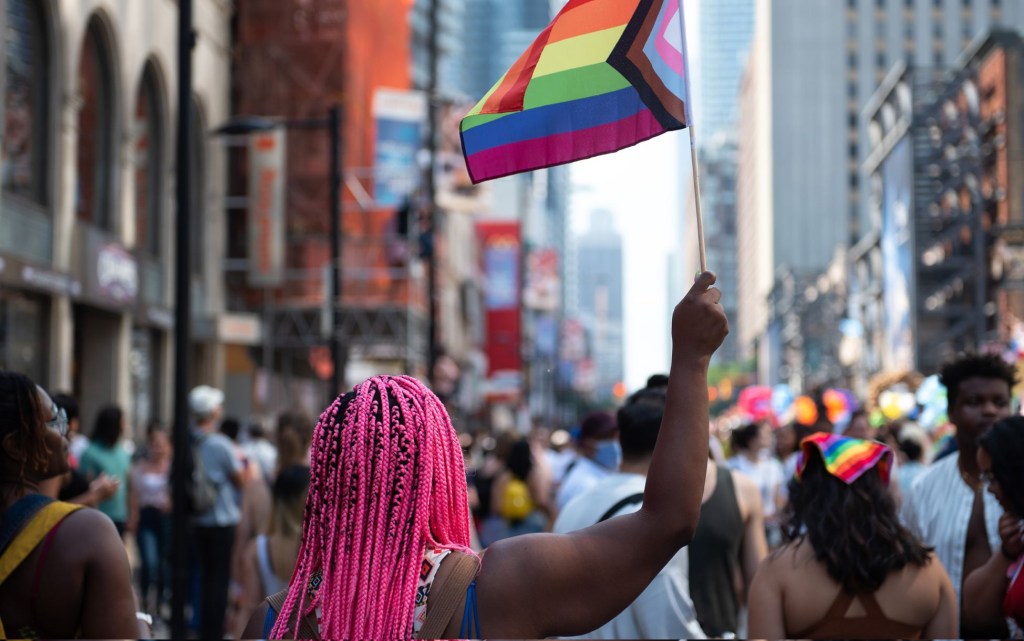
Last month, I had the chance to attend a Pride parade for the first time. An event I was able to experience in Downtown Toronto along its congested and vibrant streets.
Saying that I had a great time that day would be an understatement.
Witnessing people’s excitement during the parade, sharing laughs and memorable moments with my queer friends, and meeting new people who shared similar interests to me.
Of course though, as we see throughout Pride month, ‘rainbow capitalism’ was on full display, which was a less cheerful sight to behold. Businesses and corporate sponsors commercializing and appropriating the social movement of queer people in order to expand their consumer base. Bud Light ostensibly showing solidarity with queer people, all while their parent company has funded Republican politicians who support anti-LGBT laws1. Walmart showing off the rainbow colours, when they have donated loads of money to politicians who voted against the Equality Act2.
But I digress, since that is not the topic of this reflection, and I certainly was still able to enjoy the Pride parade.
As someone who has been in very homophobic and transphobic environments throughout their life, going to a parade like this felt like a breath of fresh air, a novel and eye-opening experience.
That being said, it did get me thinking about some things.
For many people, Pride is an opportunity to express themselves in certain ways, to unapologetically make their sexual identity known to the outside world. By adopting certain behaviour and appearances, they make an effort to be visibly gay or bisexual, something which also happens outside of Pride events of course.
Some people with homophobic beliefs then say things like, “Gay men are so weird, they have a need to always have their sexuality be known by others, and they tend to make it a personality”. This would imply that straight men are very much different in that respect.
I know for a fact that is not true.
Talking amongst each other about the attractive women they see or have seen, adopting a more performatively masculine demeanor when interacting with women, blasting music that talks about the pursuit of women as objects of desire, feeling the need to say “no homo” or “I’m not gay” when they do something that is considered more feminine.
I’m sure everyone has seen people make an effort to show that their straightness is an essential part of their identity, even at times when no one really cares.
On the other hand, there are definitely stereotypical markers that one could observe on the part of gay men.
The wearing of conventionally feminine clothing that tends to show more skin, the need to show or mention when they find a guy attractive or desirable, the admiration for loud disco music and pop music that tends to be hedonistic and lustful, the attempts to conform to certain ideals of feminine beauty, and of course the use of the ‘gay voice’ (which often imitates the vernacular and mannerisms of Black women in America, at least in the English speaking world).
I certainly witnessed these markers during Pride along with all the glamour and rainbow colours. This is all fine and to be expected of course, but I also saw some things that I wish I didn’t.
While walking with a friend, I saw a man in a crowd who was presumably celebrating Pride like everyone else, except for one thing. He was completely naked.
I also saw the same thing another day while with a different friend, except that the man was a little older so the sight was even less flattering to see.
On both occasions, my friend and I joked about the situation, saying that these people are likely using Pride as a excuse to satisfy some perverted desire.
But why would Pride be the place where they felt it would be acceptable to do such a thing? Why not at an event that isn’t designed for queer people?
I guess a sight like this is just one step ahead of those who attend the event wearing nothing but lingerie or a Speedo.
This all appears as a sort of reinforcement of the idea that queerness (a word to simply describe those who are not straight and/or cisgender) has to be tied to sexual expressions. In other words, self-sexualization, portraying oneself as a sexual object, can be considered to be a symbol of gayness or queerness.
I find this to be rather bothersome, since the idea that individuals can love people from different genders does not and should not have to be associated with open sexualization.
Of course, this is not to say that straight people do not also sexualize themselves. One can certainly go to certain clubs, festivals, and concerts to find instances of self-sexualization and sexualization of others, with women being the ones most affected.
But still, it seems that if an event is termed as ‘LGBT’, there then has to be some displays of sexualization so that people can ‘show’ their gayness.
I realize I may be ranting at this point, but I will use a personal anecdote that will hopefully illustrate the main point I am getting at.
Recently, someone came out as bisexual to a friend of mine, an occasion for which I was present. It was on a late Sunday night while we were out at a desert place, enjoying each other’s company.
While the friend was ultimately very accepting, he did have some prejudices (which I was previously aware of by the way) that prompted him to ask and say certain things.
Things like, “So do you act like a different person when you’re with other people?”, “Do you act more feminine when you’re with other guys?”, “I hope this doesn’t mean you’re gonna act like a different person when you’re around us.”, “Does this mean you’re secretly a big fan of RuPaul?”
He had certain ideas of what a gay or bisexual man was like or supposed to be like, and he wanted to, in some way, test those assumptions he had.
While you could still hold him at least somewhat accountable for having these prejudicial beliefs, there is a reason why he had them.
No one is born with prejudices like this. Beliefs like that arise from how one was raised, what they were told, and experiences they had.
You can probably tell that this friend didn’t really have close friends who were openly not straight, so his view of queer people was largely determined by what he saw in the media he consumed.
And, for a long time, media depictions of gay and bisexual men have represented them as visibly and behaviorally different from their straight counterparts3. They were stereotypically portrayed as flashy, flamboyant, egotistical, promiscuous, and even predatory.
Moreover, news coverage of LGBT events, like Pride parades, was not always very positive. I know this from experience. It would focus mostly on the more ostentatious parts of them, such as the displays of sexualization and of occasional nudity.
This can probably explain to some extent how those with homophobic beliefs or tendencies come to have a negative view of events like Pride parades or Drag shows, as they come to associate gayness or queerness with an obsession with sex and perversion. Of course, these bigoted views should be criticized as such, but one should recognize that these views are primarily a result of what they have seen.
All and all, the main concern I have is: gayness not being seen as an act or feeling, but as a type of person. In other words, a person who is gay being seen as a character or personality.
When someone hears “I have a gay friend”, one likely does not only think of sexual orientation, but a person with certain characteristics. A person who probably dresses more unconventionally, who talks and carries themselves in a certain way, who enjoys wearing makeup, whose friend group is mostly female, who likes certain kinds of media.
These are not only assumptions that are made by straight people, but queer people too. Some of them even treat them as norms in some way, using them to assess other gay people and hold them accountable.
This is seen in questions like “How gay are you?”, which presumes that a person can be more “gay” than another, due to their behaviour and preferences that fall outside of sexual and/or romantic attraction. Admittedly, these assessments are sometimes done ironically, but not always. And they still highlight how people perceive ‘being gay’ as more than just a sexual orientation.
I do not really like this idea, that being gay or bisexual is more than experiencing sexual and/or romantic attraction, that it also entails a certain personality, mode of being, and an adoption of a certain culture. This is because a) there are many queer people who do not conform to these norms and stereotypes, and b) it reinforces the notion that a person who is not straight is, in some way, fundamentally different from someone who is, a notion that homophobic people cling onto.
Destigmatizing feelings of attraction can be challenging if people still make their sexuality define them as individuals and are still obsessed with it as a way to categorize people.
Before I end this long rant, I do think two things are worth mentioning.
First, the need to talk at length about queer identities and to form an LGBT culture was largely the consequence of living in a homophobic society. When you have stigmatized gay and bisexual people, legislated against them, and alienated them from broader society, they will inevitably form a subculture where they can feel comfortable about themselves and build a sense of community. They will also protest against the social hierarchy and express themselves unconventionally as a mode of resistance. They will try to show off their ‘Pride’ in their identities, because they were previously told to be ashamed of them.
Second, things are changing. As I saw at Pride, for example, there are more and more people coming out as gay or bisexual who do not conform to certain stereotypes and caricatures, and these people are becoming more visible in society at large.
For instance, I talked about media depictions of queer people before, and nowadays there are a lot more positive representations of gay and bisexual people, ones that transcend stereotypes and caricatures of what it means to be queer. Movies and shows like Brokeback Mountain, Moonlight, Sex Education, Young Royals, and Heartstopper. I particularly like Heartstopper since it’s able to portray healthy gay relationships without needing to be explicitly sexual.
In the end, as we become more inclusive as a society, I just hope we can continue to deconstruct norms related to sexuality, such as what it means to be gay or bisexual. Perhaps, one day, we can live in a world where when a person says “I have a friend who is gay”, certain prejudicial images would not be conjured in a person’s mind and they wouldn’t make various assumptions about them.
Where being straight, gay, or bisexual is (and only is) just a sexual orientation that diverse groups of people can have, free from judgment.
I would imagine, in such a world, there would not be a need to show your ‘Pride’ in your sexuality (which historically has been done in the face of bigotry), but just the freedom to be as you are.
References
- https://www.theguardian.com/world/2021/jun/21/stonewall-inn-anheuser-busch-beer-boycott-lgbtq
- https://www.businessinsider.com/amazon-walmart-mcdonalds-companies-show-pride-donated-anti-lgbtq-politicians-2021-6
- https://mediasmarts.ca/digital-media-literacy/media-issues/diversity-media/2slgbtq-representation/2slgbtq-representation-film-television
 My Sporadic Thoughts
Leave a comment