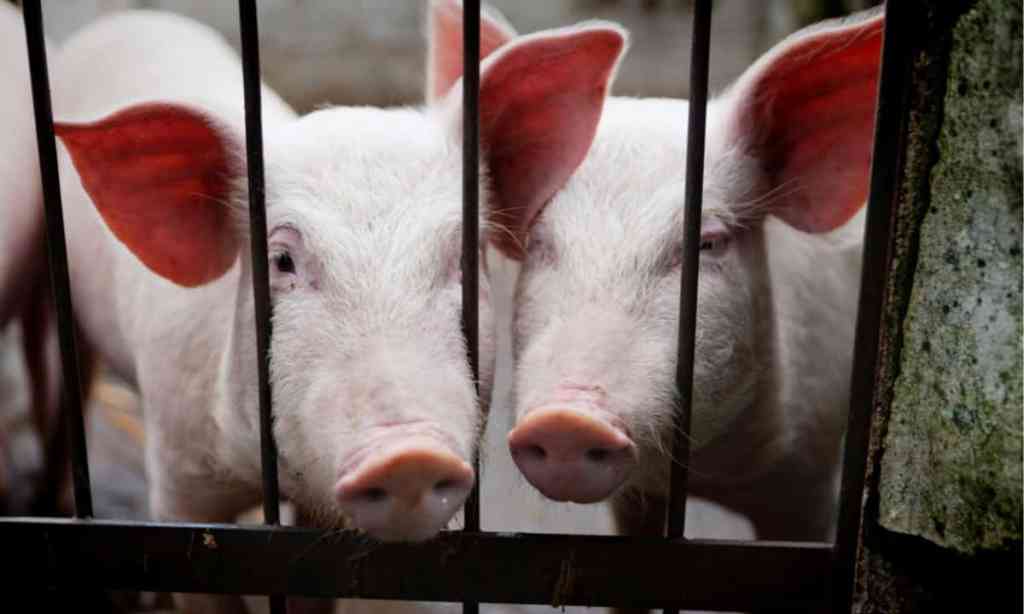
I can’t think of any particular event that led me to write this, at least not anything recent.
I guess there’s one personal experience I can draw from in relation to this topic.
It is from when I was rather young. Like 6 or 7 years ago. My mother, my first teacher, can also recall this.
The both of us were in a grocery store and my mother brought us to the meat section to purchase the final few products she wanted to bring home.
She asked the worker at the butcher counter to give her a few pounds of minced meat, as she wanted to use it to cook pasta and meat sauce later.
Like most children, I had a curious mind that incessantly wanted answers about what I was seeing. So, naturally, I asked my mother what she was buying and, most importantly, where did it come from.
My mother answered honestly. About how the meat product came to be. She didn’t go into vivid detail, but just enough to paint a picture.
That was the first time I truly learned about factory farming. About butchery in general. That we as humans commonly kill animals for our own sustenance.
I wasn’t too receptive to this idea at the time. My mother and my great aunt could tell you that I was rather bothered by it. So bothered, in fact, that I told them I wanted to avoid eating meat and become a vegetarian instead.
I stayed true to that desire for a little while. But just a little while, before returning to the old habits of my mother and great aunt. Of eating meat products.
I haven’t really gone back on that since. Today, I’m a meat eater. One that has animal-based products in most of his chosen meals.
Ought I feel morally comfortable with that? Or shameful?
Should I go back to the mindset I intuitively adopted as an innocent child? Or should that be ignored?
That is what I wish to think more about here.
The Value of Non-Humans
Though I wasn’t aware of it at the time, my child self agreed with the principles that veganism endorses.
I’m sure I don’t need to mention this for the reader, but I’ll do so anyway: Veganism as a moral philosophy rejects the commodity status that humans ascribe to non-human animals, and considers the killing of animals for human consumption to be unnecessary and unjust.
Under this paradigm, it would be a more morally just world if we were to replace animal-based products with alternatives that did not entail the suffering and killing of animals.
I will start with this: there is no reasonable or empathetic way to argue against this principle.
We ascribe personhood and moral value to human beings for a number of reasons. And there is no reason to think we couldn’t assign moral value to non-human animals as well.
Many of them, including the ones we commonly kill, are sentient creatures. They can experience suffering. Have desires that they act upon. Have the will to sustain themselves and avoid danger and pain.
Of course, their cognitive and affective capacities are generally not as advanced as humans.
But even if we were to concede that point and say that humans should be treated as having more moral value, that doesn’t mean animals should be treated as having no moral value at all.
To do so would be to imply that humans are persons (have moral value) simply by virtue of being human, and that other beings don’t have value only because they are not human.
This would be an erroneous way to perceive personhood.
We don’t value something simply because it’s human. A human cell is both alive and has human DNA, yet it wouldn’t seem to make much sense to say that it is a person deserving of moral and legal rights.
It is when these cells develop in a particular way so as to form a person with their own subjective experience. A person capable of language, reason, feeling, complex desire, and so on.
One can say non-human animals, with their different rational and emotional capacities, do not operate on the same level that humans do. Again, that does not mean they do not have any capacities that are similar or they should not be morally valued in any way.
In reality, society in general already recognizes that non-human animals are deserving of moral consideration.
They are codes of conduct with respect to how to treat pets, veterinarians to improve their quality of life, laws against animal cruelty/abuse, activists aiming to protect natural habitats, as well as movie-goers being sometimes more bothered by the suffering of an animal than that of a human on screen.
Anyway, I don’t wish to dwell on personhood too much here.
The bottom line of this section is this: There is reason to ascribe moral value to non-human animals where it can be morally wrong to kill one unnecessarily for human consumption.
It would be erroneous to think animal abuse is morally wrong (physically harming a non-human animal unnecessarily) but not also think killing a non-human animal is morally wrong.
I trust the reader can see reason to believe this.
Even if one does not, let’s assume I am right for now. That a vegan would be right in claiming that killing a non-human animal for human consumption is morally reprehensible.
My main goal is to see where the argument goes from there.
The Central Argument
Would it then be morally unacceptable to buy and consume animal products?
I will argue: party yes, but largely no.
On the one hand, yes. There would be moral issues. For all the reasons I have described, it would be morally wrong to harm/kill an animal for consumption and the meat industry is obviously guilty of that by design.
On the other hand, no. For I think there’s a different moral evaluation to be made of the consumers of animal products.
I will try to illustrate what I’m getting at with an analogy.
The clothing industry. An industry that we are all consumers of in some way,
It’s an enormous industry dominated by big-name brands and fast fashion. One that many of us enjoy participating in, taking pride in the way we dress and finding creative ways to clothe ourselves.
However, there is a lot involved in the production of garments, practices that we would be right to call unethical.
I’m sure the reader is well aware of the existence of sweatshop labour in the industry. Unsafe working conditions. Exceedingly long hours with little pay. Employers abusing their power over workers. Child labour.
With the production of clothes, we can witness persons being harmed and constrained in ways that reduce their quality of life and even lead to premature death.
Yet, countless numbers of people buy these clothes.
Now, one could say that can all act as a reason to buy other pieces of clothing instead, ones that were produced in a more ‘ethical’ way.
One can try to avoid fast fashion by thrifting, or someone can make an effort to consume clothes that were produced under safe and humane working conditions.
I will say that ensuring every single piece of clothing you own has been produced ‘ethically’ seems like a rather unattainable goal.
But putting that aside, trying to do such a thing would certainly not be wrong. In fact, it would be quite admirable.
It would be indicative of a decent moral character, at least in this context. A sign that you care about the manner in which your products are made and that you are rightfully bothered by exploitative labour practices.
There is the question though: what about the people who still buy unethically made clothes?
I do not think it would make sense to say these consumers are necessarily all immoral, in the sense that they should be shamed or punished.
There is a significant level of physical, psychological, and social distance between the consumer and the production of an unethically made clothing item.
Our global economy is in the constant process of making clothes to be put on the market. It is a multi-step process, going from the extraction of raw materials, to marking, to cutting, to sewing, to finishing, and then delivering.
It involves the coordination of labour in different organizations in different countries around the world (as exemplified in the “Made in China” and “Made in Bangladesh” tags you often see on your clothes).
The harm and exploitation that people were subjected to during the production of the item has already been done. You did not personally initiate or manage its production.
When you are in the store purchasing the item, you are largely unaware of all the specific things it took to make said item. You don’t personally know any of the people who actually produced it, having no personal connection to the labour process.
And even if you personally decide not to purchase the item, the market will either sell it to another consumer, or dispose of it. Only for the market to make another clothing item again and again.
Granted, it would be nice for a person to still abstain from buying an unethically made clothing item. But the distance between the consumer and the production means that you wouldn’t be committing a moral offence against someone in buying that which has already been made.
This point about the morality of buying clothing items can apply to other industries, ones that also rely on exploitation and inhumane working practices.
The production of our jewelry. Our electronics. Our fruits and vegetables.
I trust the reader can see where I am going with all this.
I think this reasoning can similarly apply to the distribution of animal products.
A consumer is so far removed from the making of the animal product that it’s not reasonable to think they themselves are committing a moral offence simply by buying the item.
The consumer had no say in how the product was made. They themselves did not harm or kill the animal.
By the time the product reaches them, the moral harm has already been done.
And even if they do not buy it, it will just be bought by someone else, or thrown out. And the enormous market for animal products will carry on.
Since they are not an active participant in the harmful production process, they cannot be held responsible for it.
Implications/Clarifications
Now, I want to speak of an implication of this view. One that could be concerning.
We can go on to talk about more extreme production processes.
Someone could say that my line of reasoning can apply to a mode of production that most people today deplore.
Chattel Slavery. Having slave workers treated as literal property.
It goes without saying that this production process entails an unspeakable amount of harm, exploitation, and inhumane treatment.
But, let’s say the majority of our food and clothing is produced through slave labour.
There are some interesting things to explore here.
There could be the question about what would be more problematic: production involving the enslavement of human persons, or production involving the systematic killing of non-human animals.
A person could say that the animal product economy is worse since it entails more suffering on the whole, with non-human persons being killed in countless numbers. Another could say that since a human is higher on the personhood scale, human slavery would be more problematic, even if the humans are not being systematically killed.
In any case, both economies involve immoral actions for their maintenance.
Now, would it be immoral to participate in the economy with slave labour?
Yes and no.
On the one hand, the argument about moral distance that I applied to animal products would also apply here. The consumer had no say in how the product was made and the harm to the slave(s) was already done. And the product will be sold or discarded regardless of whether the individual consumer buys it, and the economic cycle will continue.
On the other hand, there would still be ways to participate in the slave labour economy that we could say are immoral. Ways that involve a person directly enacting harm against humans.
It would still be morally unacceptable for an individual themselves to own slaves, since doing so means they are personally enacting harm on others and stripping them of their freedom.
For the same reason, it would be wrong for a person to work as a manager of slaves or a decision-maker for an organization that uses slave labour, when they can take another job instead.
Also, let’s suppose the individual consumer has more power over the labour process. The consumer buys products from a seller who uses slave labour. If the individual consumer refuses to buy from the seller because they used slave labour, the seller will stop using slave labour for their business. In this case, the consumer does in some sense have control over the labour process; hence, it would be immoral to buy the product.
Finally, if there was a social movement that advocated for the replacement of slave labour with a more humane labour process, it would be morally wrong for someone to actively fight against said movement.
I think these assessments regarding the slave labour economy can be applied to the case of animals. We can take certain actions to be immoral within an economy that produces and distributes animal products.
For one, it would be immoral for a person to personally go out and kill an animal for consumption. If one can get access to vegan alternatives or purchase animal products that have already been made, there is no moral reason for them to personally enact harm to animals by killing them.
This would apply to people who choose to go out hunting animals for consumption, and definitely those who do it for sport. Thus, even in an animal products economy, hunting as a leisure ought to be banned.
There are also certain animal products that would be immoral for one to buy, because you yourself would be enacting harm or commanding the killing.
A good case in point is buying lobsters. Lobsters are typically not put on the market already cooked or dead. Once lobsters die, bacteria quickly multiply within them and produce toxins that can cause food poisoning. It is for this reason that they are quickly eaten after they are killed, and a common method of execution is to boil them alive. They are either killed only at the point of purchase by the seller, or by the consumer after having purchased them.
Since the harm and killing hadn’t already occurred and would only take place if the consumer chose to buy the lobster, it would be morally wrong to buy it.
If a consumer can make an individual purchasing decision so that an animal is not killed, they ought to make that choice.
Also, it would be unethical to work in the animal products economy as someone who harms and kills animals. This includes those who slaughter animals, those who transport animals to be slaughtered, and the executives who manage and control the industry. Producers who create animal products in the first place.
Finally, it would be wrong to actively fight against large-scale efforts to replace animal products with non-animal-based substitutes. Political measures to increase the production of vegan goods in our economy while reducing the number of animal-based goods. Investment in research for vegan-based agriculture and production. Tax credits to vegan stores and restaurants to incentivize their establishment. Efforts to make vegan products more affordable and accessible to all. And even a push to outlaw the killing of non-human animals for consumption.
All in all though, if all an individual does is buy goods derived from an animal that has already been killed and put on the market, I don’t see much reason to deem that action itself to be morally wrong.
Instead, top-down measures to move away from animal-based products should be the priority, the collective/societal goal. If the aim is to create a more vegan society, it is also arguably more effective to do that than to individually try to convince each person they should stop consuming animals, given how pervasive animal products are in a lot of peoples’ cultures.
I’ll bring this long post to a close now. I’ll end it with two more thoughts.
First, I hope it’s abundantly clear that I think a society’s voluntary choice to consume animals when they can instead be vegan is a moral crime worthy of condemnation.
Obviously, different societies will have varying levels of ability to be vegan, based on their size, level of development, and access to food. Nevertheless, the rich and developed countries we see today definitely have that ability. All that is absent is more political will to move away from animal products.
I do believe it’s rather plausible that in X amount of generations in the future (if we are all still around by that point), people will look back at how we killed non-human animals for consumption with utter moral disgust and shame. Similar to how we largely today look back at practices like disenfranchisement and human slavery as things that were clearly wrong and discriminatory.
It is downright hypocritical and irrational to be against animal abuse and to cry at a dog dying in a movie, but yet condone the killing of animals for our own consumption and enjoyment.
That is why I will always applaud those who personally choose to be vegan.
Second, as I was writing this, there was a question in my mind about this whole post itself: is this all just a post hoc justification for my own behavior?
Since I was young, I have always been personally uncomfortable with the fact that we raise and kill non-human animals for consumption. But I also have desires to eat various animal-based products that I like.
So, perhaps the effective purpose of this post is to provide justifications to myself for behaviours I’m already engaging in.
I could try to be bold enough to say it is because of the things I have written that I chose to be the kind of consumer I am, but a reader can understandably be skeptical about that.
I will say that regardless of whether these justifications are post hoc or not, I still believe that the arguments I made concerning animal products and moral distance are reasonable and sound. To the point that I hope a reader can follow the points I made and take them to be at least valid and potentially persuasive to some. That was ultimately my goal here, as with everything I write.
If anything, this post about animals can just provide me and my younger self with an illustration of one thing. Of how troublesome and inconsistent the society they were born into really is.
I mean, it is troublesome and inconsistent in many ways. Our treatment of non-human animals is just one of them. One that we may, one day, collectively recognize as such.
 My Sporadic Thoughts
Leave a comment